
Sunday, May 7, 2006

Nikon SB-800 Heaven

If you are a Nikon SB-800 owner, let me first congratulate you on your apparent disposable income level.

Now that we have that out of the way, you may be interested in this link:

SB-800 Resources (Thanks, Doug)

Also, if you are bored out of your gourd, here's a quick news flash:

You can play with an "interactive" iTTL Flash demo, which is on the Nikon Japan site. It, of course, uses flash programming. And this link will get you there in a, uh, flash.

OK, Folks, Strobist Flickr is Live

First of all, mucho thanks to 'Captoe,' who set us up with a group (and educated me as to how to use it.)

This is a place to stick you cool flash experiments - successes and interesting failures.

There's only one rule: The photos have to be "work safe." Which is to say that they won't get anyone who is browsing at their desk (when they should be working) canned for looking at your stuff.

In other words, while I am sure your main squeeze's (fill in body part here) looks great in your cool new light, this ain't the place.

That said, throw up whatever you want. You may note that Flickr does make the meta data viewable for many caption plug-ins. So if you are trying to protect the innocent with respect to names, etc., kill your captions before uploading.

Here's how to join the fray:

A) Join Flickr (for free) here.

B) Join Strobist group here.

C) Upload your photos:

• By browser: here.
• With the uploader tool: here.
• By e-mail: here.

D) Add appropriate photos to the Strobist group. (Either during the upload process, or later from the photo's page.)

E) Add tags. Tags are like labels or categories. Strobist photos might be tagged with pertinent words like snoot, gobo, hardlight, softlight, ambient, etc.

F) Follow the tips for a Happy Flickr Group here.

You're good to go. Please feel free to comment (be nice) on others' work. Trade ideas. Ask question. Answer questions. You get the point.

This page will be archived to the sidebar for future reference.

And again, thanks to Captoe. (Whatever a 'Captoe' is...)

Saturday, May 6, 2006

Pocket Wizard Layaway Plan

I'll bet that headline got your attention.

It's a cheap teaser, but based in truth.

A Pocket Wizard set uses connector jacks that are like a set of earbuds, but in mono instead of stereo. They are called 1/8" mono plugs.

If you wanted to build a synch cord that would allow an easy transition to PW's, you could use a cheap audio cord as the middle part.

This would mean that the connector-end PC cords that you bought for your 1/8"-audio-jack-based, pigtail synch cord would fit your PW's when you were ready to step up to $330 of wireless synching bliss. You could also use it as a backup when the PW's batts went dead on you.

Ha, ha ha! Just kidding! Pocket Wizard AA's last 250 hours. That's ten days, turned on, in your trunk before you're in trouble. And if you go ten days without using them, you don't deserve them anyway...

(OK, sorry. I have to stop posting late at night...)

Ahem.

Anyway, I'll look into sourcing a 20-foot 1/8' extension cord and a female-to-female adapter to see if it is worth doing to save money in the long run. (You'd need the F-to-F adpater to make a "socket" at the male end of the cord.)

That Synching Feeling

Do you know what your camera's real synch speed is?

As you probably know, when you stick a TTL-compatible flash up on your camera's hot shoe, the two talk to each other and the camera limits your shutter speed to your highest full synch speed. Usually, this is 1/250th.

Well, the camera does not talk to a PW transmitter (or a garden-variety synch cord) so it does not know to limit the shutter speed. I was shooting at an assignment today using a strobe off camera and a Pocket Wizard as a trigger.

What I found (with a little popping and chimping) was this:

I could get full frame synch at 1/320th, most of the middle of the frame at 1/500th and a predictable and usable third of the frame - mostly in the middle - at 1/800th.

I don't know about you, but I get all tingly inside just thinking about what I could do with a 1/800th synch speed.

(Uh, I didn't mean anything weird by that...)

If you can put the needs-to-be-lit part of a subject in that third of a frame (like, say, the face of an outdoor portrait subject) you have effectively made your strobe more than twice as powerful. The higher shutter speed means you can drop the aperture, making less flash do more. Cleaner backgrounds, too.

I am going to do some real testing and stick the results up in a longer post, but you might want to play with your camera and see what it'll really do using this technique. TTL off-camera cord users need not apply. The body basically thinks there is a flash up there on top.

Yet another reason to get the flash off the camera. As if we needed one.

Flickr, It Is...

There seems to be a good consensus for Flickr. Captoe has already set up a group called Strobist here, prompting my crack team of copyright lawyers to fire up the fleet of black helicopters and head his way.

Actually, Captoe, if you want to handle the invite approvals and e-mail me with an easy instruction set telling people how to post the photos, I will set up that info on Strobist (the blog) and we can get busy.

One more thing. If you keep your photos sized at 400 (total) pixels on the long dimension, they will fit nicely on the blog should they happen to get brought over into an article or "how-to" post. At that size, it should be easy to jpeg them to get them down to ~75k.

I have seen other blogs (on Blogger) that have a little Flickr slideshow refer box thingie in the sidebar. So I will check into how to do that, too.

Please do not use the Flickr messaging system for any important communication. I will probably check it every leap year or so. (I need another in-box like I need a hole in the head.)

And, for the pop-culture-illiterate, (or foreign readers) "Help Me, Rhonda," was a song by the Beach Boys.

Thanks, guys!

Friday, May 5, 2006

Help Me, Rhonda.

Alright, folks. I am hoping the Collective Strobist Reader Brain Trust can yield an idea or two.

The goal: To set up a publicly available place for you guys to stick your lighting triumphs and interesting failures so we can all see them.

The venue: Not here. (Because it would drown me with work, cause me to neglect Mrs. Strobist and probably land me in divorce court.)

I don't use any of the online photo community sites, so I don't know squat. But I want readers to be able to submit photos to some sort of "Strobist account" somewhere, with the abilty for others to comment (and trade ideas) attached to the photos.

Got a suggestion? Fire away in the comments section, and we'll see what we can accomplish.

I'm all ears.

On Assignment: Use a Second Light to Create Tension

Back in the 1980's, I did a lot of freelance for a really visual, cutting-edge publication called "American Banker - Bond Buyer."

Now, if you were to detect a note of sarcasm on the visual quality of AB-BB in my voice, you just might be right. But the assignments were quick and dirty, they paid pretty well and those folks sure knew how to turn a photography invoice around fast. Which made them triple aces in my book.

Suffice to say that the assignments were mostly of the "white guys in ties" ilk. So variety wasn't exactly the strong suit there.

Being a young photographer, I would lug the White Lightnings to every job and usually blast it all to f/16, thinking that is where the quality is.

As is frequently the case when in the youth of our careers, my approach was all about power. But that was at the expense of subtlety, control and ceative use of tension.

A really nice lady whose name escapes me used to call in my assignments ("shoot this guy in this boring, florescent-lit office," etc.) and send me on my way. So I would drag the Big Lights out and softbox the guy to death, thinking I had done a fine job.

After a while, she started suggesting that I "stick a second light in there - in the back somewhere."

She knew what I didn't: That a second light, coming from a radically different plane, could help the photos to "pop" on a typical, high-dot-gain newspaper page.

What I see now is that I had plenty of light (too much, actually) but it tended to come from the same direction. When I used a second light, I would use it as "fill" for the main light. (Can't have interesting shadows, can we? No, no, no.)

So the light was there, but there was very little internal contrast (for lack of a better term) in the photo.

These days when I pop the second strobe into a photo, it is likely to be aimed right back at the camera. (Either my subject or something else in my photo is blocking the light from the camera's point of view.)

Sometimes I will use the second flash to light the background from an oblique angle. But either way I am creating a second plane of light that can be controlled independently to adjust the tension and internal contrast in the photo. This is especially important when your work is going to be reproduced in a newspaper.

You show me a photo with enough internal contrast, and I will show you a picture that will repro darn near anywhere.

In the top photo above, I used a standard SB-light-on-a-stand up high and at camera right. (Remember - check the nose shadows to see where the main light comes from.) This would have been okay, but adding the second light in the back really makes the wire spools kick. This company, by the way, runs Cat-5 wire and the like to install network for corporate clients.

When you are just starting out with this backlight stuff, the question arises as to how "hot" to make the light in the back. Fortunately, the answer is that it really doesn't matter. There is such a wide range of brightness (relative to your main light) that you can use. And almost anything you do is gonna look good. Honest.

Let's use this photo as an example. If you just wanted three-dimensional-looking wrap-around detail in your wire spools, you might start out with the background flash putting out the same light as the foreground.

But you could up the background flash by a stop if you wanted. Or two. Or three. And none of them would look bad. They would just look different. It's the closest thing you will ever get to a "horse shoes and hand grenades" fudge factor in lighting. Don't believe me? Try it and see for yourself.

And here's another trick. You know that CTO gel you keep religiously near your flash? You can warm up that back light to create some color contrast, too. (Don't try it with the green gel. It looks, well, rather pukish.)

Here's the process. This is a pretty dark room, so lets assume the ambient will not really come into play in the light, as long as we have a pretty fast synch speed.

I set my first flash up at 1/8 power (direct) and did a couple of test pops to nail down the working aperture. Then I stuck my other flash in the back, laying on a cable spool behind the guys. I set it to 1/8 power with a CTO gel on it and tested it by sticking my hand in front of the lens to block the background flash - just like my subjects would.

I do this nearly every time while checking the effect of a backlight. It saves wear and tear on your subjects as you can set up the light without them.

The light was fine as it was, but it looked even better when I cranked it up another stop. So I shot with the background light set to 1/4 power.
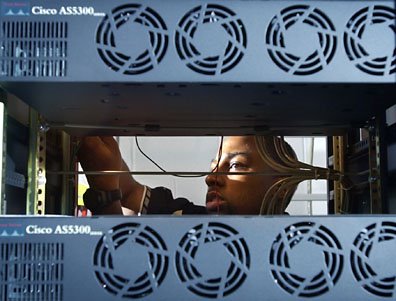
The seond photo is sort of a reverse of the first. I started with a light high and to the left (with a snoot) to pop the guy's face. I based the working aperture on him. Then I lit the computer equipment with a second light, testing popping and chimping until I got a good ratio.

Note: "Chimping" is a slang term in the US for digital photographers that shoot a picture and then hunch over their camera looking at the image on the TFT. They are frequently observed making sounds like, "Ooh-ooh-ooh," (not unlike a chimpanzee) if they like the photo.

Super accurate? Nope. But pretty darn close.

Quick? You betcha. These two were from the same assignment and they were both made in a span of about 10 minues.

It's funny, but now that I think of it I rarely use more than one strobe when I light. It's mostly because of speed issues, but also remember that I co-opt the sun or whatever other ambient is around to be my second light source by balancing as explained in Lighting 101.

This gets me through about 80% of my assignments, with another 15% being lit with two strobes and 5% being done with three or more. That is one reason I recommend adding a cheap, single-light bag very early in your equipment purchases.

You can do a lot with just one light. Just don't hesitate to stick the second light back there when it will do you some good.


Next: Womens Lacrosse Cover
Share

Twitter Delicious Facebook Digg Stumbleupon Favorites More