Friday, September 1, 2006

No Synch Cord Required

David is on assignment, but he left the door unlocked...

If you happen to have a Nikon D70, D70/s, or D200 body and an SB-600 or SB-800 speedlight, you are already well on your way to a Starving Student Off-Camera Lighting Kit. The flashes will talk wirelessly with those bodies, meaning you do not have to buy a synch cord.

All you need to do is to learn how to use the Nikon Creative Lighting System to let your camera's built-in flash trigger the speedlight.

At KenRockwell.com, there's a tutorial to help you get your camera and flash talking to each other. He even shows you the exact sequence of buttons to push.

It's designed for TTL usage, but you're better than that. Trust in The Force and choose manual.

By Mike H.

Thursday, August 31, 2006

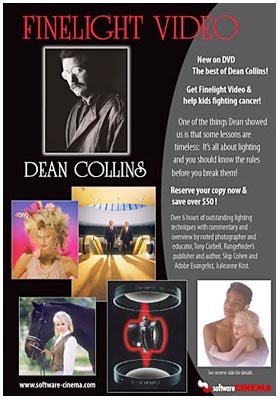
Review: The Best of Dean Collins on Lighting

To appreciate what a Lighting Rock Star Dean Collins was in the late 80's, you really had to be at one of his seminars.

Imagine yourself and a couple hundred other photographers sitting, mesmerized, in a hotel ballroom as a half dozen synchronized Hasselblad slide projectors took turns unlocking secrets and opening doors in their brains.

And talking non-stop at the front of the room was Collins, never standing still for a moment. His hands constantly gesturing, his delivery machine-gun fast. But somehow, your brain processed it all.

You were a rat and he was the Pied Piper, leading you out of the dark ages.

There was no time to take notes. It was enough just to listen and try to keep up with the guy. And you couldn't not pay attention. Because you were starting to get it.

And he couldn't slow down if he wanted to. Because he had so much to tell you.

Those of us who are a little older remember how his techniques took the commercial photo world by storm. He started out playing with PVC pipes to make his own gear. Soon, Bogen was marketing "Lightforms," which were designed right out of his "Tinker Tubes" notebook.

All of this lighting mania led to a series of books, and later, videotapes. Photographers watched them repeatedly. And they adapted their methods to embrace what they had learned.

Sadly, Collins passed away last year after a three-year fight with cancer.

Thankfully, his willingness to share his knowledge via books and VHS tapes means that he will be able to go on teaching future generations of photographers.

The Best of Dean Collins on Lighting is a new, 4-DVD, 6-hour compilation of the best of his VHS series.

And the one weakness in these DVDs stems from the state of the art in video production at the time the VHS tapes were produced. You'll notice a lack of the sharpness and resolution that we all take for granted in this day of HDTV and 10-megapixel consumer cameras.

But the weakness stops there.

The content of these tapes is timeless. The clothing styles may scream 1980's, but the lighting techniques are just as valid today as they ever were.

And unless someone repeals the laws that govern light and physics, they will continue to be applicable for the foreseeable future.

The "Best of Dean Collins on Lighting" DVD set began shipping this month.

Mine arrived via UPS as I was waiting to pick my kids up at the bus stop. I saw the brown truck drive past. I saw him pull up to my house. I knew what he had for me.

But when you have a five-year-old who has just started kindergarten, you don't bail on him to run back to your house to see the new DVDs. You pick him up at the bus stop.

About three years later the bus arrived with Ben and his older sister, Emily. We headed back to the house.

All four DVDs ship in one double-width clamshell case. The first three discs contain between eight and ten full, commercial shoot breakdowns. Disc number four is simply entitled "Basics."

It is disc four that you should watch first. In it, Collins introduces you to his philosophy of lighting by using one, small battery-powered flash. Before it is over, he will show you the big guns at the big shoots. But the principals hold true right down to the small stuff.

As you watch it, you learn about the different areas of a lit, 3-D object. If terms like "diffused highlight" and "specular-to-diffused transfer" mean nothing to you now, get ready for them to start popping into your head every time you hold an apple up to the light before you take a bite.

Collins takes us through several portrait shoots using one modestly-powered flash - and a high-powered brain. These are the early productions, and he was still using some home-fashioned light control gear.

That's a good thing, because the commercial Bogen versions are very difficult to find these days. Maybe on eBay, if you're lucky.

But that's okay, because you can make this stuff. I'll be making some panels and documenting the process on this site soon. More fun than buying it, anyway.

Your appetite whet by the basic concepts, you are off to the races.

There are 27 shoots broken down in the remaining three discs. Each one of them will leave you with a mixture of awe and a feeling of "Hey, I could have done that!"

That's because he was (is) such a good teacher. And he doesn't just teach you a bag of tricks, either. Along the way, you learn how to think about light. Midway through the DVD's you find yourself anticipating the solutions to the lighting problems he faces.

I would imagine it is very much like the experience of a fellow photographer I know who spent most of his childhood in his native Korea. Years later, he stopped in amazement while walking down a street in the US. It had just occurred to him that, for the first time, he was thinking in English.

There are far too many examples to do the DVDs justice, so I will run through some of my favorites:

• A pair of tennis shoes, shot on 8x10 film, and exquisitely lit from all angles (including underneath) for a catalog shot.

• A stunning, "in-motion" shot of a Yamaha street bike and rider shot on 8x10 large format and lit with four, small quartz lights. And 8-seconds of exposure time in which to do some quick, in-camera "Photoshopping." (The ubiquitous program was not yet invented when this photo was made.)

• Various, outdoor photo sessions that turn ugly, mid-day light into a beautiful environment using reflectors, diffusers and mirrors. So, yeah, magic is done with mirrors.

• And this annual report cover shot in five minutes (with lots of prep time) at an airport with two airline executives:
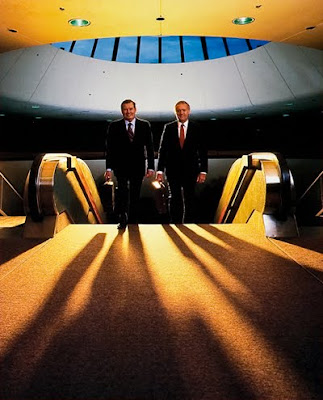


This image reminds me of a favorite story Collins used to tell.

This was one of those instances where he used about a gazillion watt-seconds to transform a large, ambient environment for a photo. As it happens, he was using optical slaves to trip the lights.

Well, they had everything all set up and were waiting for the execs when an elderly Japanese couple walked by with a small, point-and-shoot camera.

If you are a photo bug and walk past a setup like this, you're gonna want to snap a souvenir shot. Even though your camera only has a dinky little flash that cannot possibly ever hope to light such a big area.

Except for this time.

In the instant the the tourist tripped his shutter, thousands of watt-seconds were released as all of the strobes went off at once.

I would have loved to see the look on their faces. I would also love to see their picture.

They learned a lot about light that day, too.
Wednesday, August 30, 2006

Making a Good Idea Even Better

One of the coolest things about starting up a website has been getting a peek behind the curtain at how some of the normally hidden stuff on the web happens.

One of my strongest impressions has been that Google will someday own the world. They are an amazing machine.

They make available - for free - a set of statistics on the daily site traffic that just continues to boggle my mind.

I can see which are the most popular pages, and develop those to basically give people more of what they want.

I know that people are logging on daily from more than 50 countries. (Estonia? Who knew?)

I know where people are likely to spend the longest amount of time. (On the essays.)

And if you have a webcam on your computer, I can actually see you while you surf. To the guy in Spain who likes to read "On Assignment" at 3:00am wearing nothing other than a pair of hot pink boxer shorts:

Please. Stop.

Alright, so maybe I am kidding about the webcam part. But the stats really are amazing.

The most telling is the list of referring sites - where people come to Strobist from.

And site number nine on yesterday's list was a place called www.fredmiranda.com. Never heard of it. But, apparently, some of you guys have.

So, out of curiosity, I moseyed on over and took a look through Fred's site last night.

Now, Fred is just your typical guy, with a typical story:

Born in Brazil, studies Architecture Design and Computer Science, wins the national bodybuilding championship, moves to the US, becomes a model (LA, New York and Milan) and later goes on to study computer graphics at UCLA. And now he runs FredMiranda.com, a pretty kick-butt photo site.

You know, pretty much the typical web publisher profile. My story, as you can imagine, is much the same. Yawn.

(Oh, and ladies: He's taken. Married 12 years with two daughters. Sorry. My wife was bummed, too.)

So, in addition to a site that is worth checking out in general, there are also some cool articles on how-to and the like. Which brings me to the purpose of this increasingly long-winded post.

On this page is a tutorial on how to build a little softbox for your flash. It's a cool little idea, that could be made even better with a little evolutionary thinking.

First, you could GET THE FRIGGIN' THING OFF OF THE CAMERA! (Sorry, little kneejerk reaction to on-cam flash there. Please excuse.)

But anybody could do that. What kept me awake last night was trying to figure out a way to design this softbox to where it would be collapsible. That way, I could carry two of them (face-to-face, for protection) in a little notebook in my trunk. They'd be ready to use - and undamaged - at any time.

I had a dawn assignment today, so I fell asleep before it came to me. But I thought I'd also flip it to you guys, since many of you are also cheapskates DIY afficianados.

Take a look at the tutorial (and the rest of the site, for that matter) and see if you can come up with anything. If you get a good collapsible design, start a Flickr thread and lets see if it can be improved.

Get in touch with your Inner MacGuyver. And if you build it, use the thing off-camera for Pete's sake.

Tuesday, August 29, 2006

Starving Student Gear Too Rich for Your Blood?

You might want to take a look at Jesse Crouch's website, IFakedIt.com - especially his article on small-budget photography.

In it, you'll find tips on how to score a very cheap-but-good digital camera, using (continuous) work lights as a cheap sub for strobes and a cool, free alternative to Photoshop.

Thanks to PotownAl for the heads up.

By David H.

Monday, August 28, 2006

On Assignment: Shoot Your Shiny New Gizmo Like a Pro


About six weeks ago, I posted an article about how to make a darn-near free macro studio. I included photos of a flower/phone/radio/etc on white poster board.

What I saw afterwards was (mostly) a lot of small things on a white infinity sweep. But the point of the little el cheapo contraption was that it could be used to create many different lighting schemes.

So today, I wanted to do a shoot using a the same type of lighting box to get a completely different look. This is the typical type of thing you might need to shoot for a quickie product shot, to throw some shiny new gizmo up on your blog (in style) or for an eBay auction.

In case you forgot and missed the link above, here's how to make it.

For this shot, we'll be isolating the subject by using a black reflective surface. You might think a mirror would be better, but you'd be off base. A mirror reflects from the rear surface, unless it is an expensive and fragile "front-surface" mirror. So there would be a double reflection from this oblique angle.

Today, our gizmo will be sitting on 144 square inches of polished black granite, courtesy Home Depot's tile aisle.

Total damages: $5.49.

Gotta love scoring photo gear at The Big Orange Store.

The polished top surface will reflect the background nicely if we shoot from a low angle, allowing is to light the subject and everything else on two different planes.

This is pretty cool, as the subject is resting on something that can now hold a tone or color completely different from what would happen if the camera were sitting on, say, poster board. You'll want black, so the tile's color won't bleed through.

At top is a vertical photo of a Nikon Coolpix L4, which is my wife's garden-variety point-and-shoot digital camera. I chose it as a subject because it is reflective (which can make something more difficult to shoot) and has a complex surface.

I am going to walk through a series of photos, explaining the changes that lead to the progression of looks.


First off is a swap from vertical to horizontal orientation. And I figured it would be better to have the Freudian part extended for the shot, too.

The first stab at this is with a light coming in each diffused panel pretty equally.

You can adjust the lighting angle by rotating the whole box under the subject by up to about 30 degrees in either direction. Then simply turn the subject to compensate.

I like the way the left light defines the left side of the camera, making it look three-dimensional. But I have plans for the second light. So I have to illuminate the left side some other way.


This does it with one light on the right, and a fill card card (a folded piece of white paper) placed just out of the frame in the camera-left front of the subject.

A little counter-clockwise rotation helps me to pick up the reflection of the right diffusion panel in the front of the camera lens at right. Which now proves that there is, in fact, glass in there. Better than the black hole in the earlier frame.

So, now that I am doing all of this with one light (an ugly, hard light before we gussied it up) I am free to play with my background with the second light.


Here's a wide shot showing the overall look after adding a sheet of cheap blue craft foam (coulda been paper) for a background.

Total damages: $0.59 at local craft store.

Note that the diffusion is out in the left panel. I have the left flash dialed way down and it is lighting the background directly. You see the fill reflector piece of paper here, too.

It is important to mention that I could have done this with two plain old desk lamps, too. Just balance to tungsten, tripod the (shooting) camera and move the lights in or out to alter the lighting ratio.


We keep the background light from contaminating the subject with a piece of cardboard as a gobo, as seen here. The aiming is easy if you sight it from the direction of the background light, which is also what I did for this explanatory shot.

No modeling lights needed. Just use line of sight.


So, here's the effect with the background light added. Blue always connotes tech to me for some reason. But you could use anything.

IMO, this is fairly nuanced light for two small sources, a piece of tile and a cardboard box.

This little light box is a frugal, felxible, go-to piece of gear that works as well for small-product catalog shooters as it does for eBay'ers.

Long story short, if you are willing to learn to play with the $10 DIY Macro Studio, it'll earn its meager keep by delivering small object photos with impact.

Next: How To Light A Comet

Sunday, August 27, 2006

Hey, THAT Ought to be in Strobist...

We are 200 posts into this strange trip, with well over a milllion page views to date.

Up until now most of the posts have come from yours truly, save a couple of outstanding On Assignments where the photos were reader-supplied. And many reader-supplied tips via e-mail. And I have darn-near worn the keys off of my Powerbook in the last six months.

Here's something you probably never expected to hear from a control freak particular person such as myself:

It's time for a little diversity of thought.

Starting soon, the sharp-eyed among you will start to notice an additional byline or two. But that's not all.

I have found that some of the most obsessive loyal Strobist readers tend to hang out on the Strobist Flickr discussion boards. Lots of cool things pop up there, and many people miss out because they are too flippin' lazy busy to join up to Flickr.

And since many of the stalkers most helpful readers regularly send me tips via e-mails, I wanted to kill a few birds with one stone.

I am starting a "This Oughta Be in Strobist" discussion thread as a place to stick stuff that you think might be of interest for the broader readership.

We are all about credit here at Strobist. Because I am short on cash. (Ba-dump, ping.) So please credit where you found the info.

And if it is on site "A," but you found it via site "B," we'll want to credit them, too. If there is a photo, link to it so I can find it.

The result will be more neat stuff popping up more frequently. Especially when I am crunched during NCAA and NFL football season.

And since you have access to the raw feed on Flickr, you'll see the stuff as it is submitted. If for one reason or another, it doesn't pop up to the main site, it'll still get exposure there.

I want to say right now that I will still be pretty choosy on what to pull up. Strong preference will be to neat stuff that applies to off-camera flash.

But some other stuff is pretty cool, regardless.

Let's see how it goes for a while. Feel free to post here.

Now THIS is Cool, Off-Camera Light

OK, it ain't flash.

And it is already making the rounds.

But I am big into any creative use of off-camera light. And leave it to some Japanese performance artists to come up with this.

What is it? An animated series of light-painted time exposures, of course. This has to be difficult. If I had some free time, I would try it.

Scratch that. If I had free time, I'd get some sleep. But when I woke up, if I was well-rested, had nothing to do and it was dark, I'd try this.

See more examples from Pika-Pika on their website. Original tip via DSLR Blog.

And if you have 4 minutes you can devote to sitting at a computer with your jaw hanging open, check out this animated short film they made.

Absolutely amazing.

(Nice find, Chris.)

Share

Twitter Delicious Facebook Digg Stumbleupon Favorites More