About thirty years ago I was 11 years old and sitting at the electric piano at the (Umatilla, Florida) home of my way cool, just-out-of-college piano teacher, Jane Trosper.
Ms. Trosper was no knuckle-wrapping, wrist-posturing, scale-demanding piano teacher. She was different. She was a child of the 60's. She was laid back, happy-go-lucky and seemingly locked in a perpetual groove. She was the kind of teacher who would just subtly nudge you in different directions and let you think you were discovering wonderful things all by yourself.
She was about feeling the music. She even played in a "combo" in the evenings. She was groovy.
And it was at one of those after-school piano lessons that she delivered what may be the earliest Moment of Clarity that I can still remember as a middle-aged adult.
I was having trouble working out a difficult passage when she casually leaned over to me and said something to the effect of, "You can do this. You are a great, great, great, great, great, great grand-student of
Franz Liszt, you know."
What?That's right, she explained. She could trace her piano teacher lineage back to the great Hungarian pianist and composer, through a series of piano teachers through the ages.
Which meant that, now, so could I.
I never became a great pianist. But the instrument brought me countless of hours of happiness and creativity. I suspect it also made me better in math. (There's a lot of correlation between the two.)
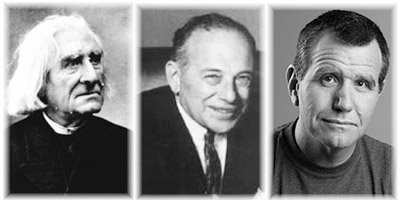
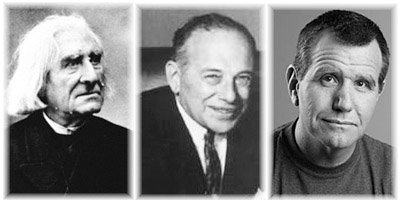
And I always took extreme, if undeserved, pride that I could trace my piano roots back to good ol' Franz. (That's him at top on the left, by the way.) I suspect that he looks down at me with a tad more indifference. But that's beside the point for the time being.
My connection to Liszt was the first time I had ever considered the idea of a historical mentor - even if a far-removed one.
I have kept the concept in mind throughout my life, in a variety of areas. And I have applied it to some wildly disparate subjects.
Having someone for an historical mentor may not be as good as being that person's actual first-hand student. But you can be pretty picky about who you choose as a mentor as you delve into a new area of knowledge.
For example, I have been an investor for about 25 years. I started very young, on an informal basis, with help from my dad.
As I became an adult and really started getting into the idea of analyzing stocks for investment purposes, I discovered Peter Lynch. He was a stock picker who rode the great Franchising of America wave in the '80's to create billions upon billions of wealth for his shareholders in the famed Fidelity Magellan mutual fund.
He was generous enough to write a few
great books, too. I happily devoured them. But I also looked back to see who
his mentor was. Turns out it was none other than the richest man in the world -- and self-made, at that -- Warren Buffett. So I read everything I could
about Buffett, who thankfully for his shareholders spends his time managing money and not writing books.
And I kept digging.
Turns out, Buffett was an actual student of a man named
Benjamin Graham, who is widely considered to be the father of financial analysis. He was the first - and probably the best ever - value investor.
Boring? Yup. But as close as you'll ever get to having a money tree growing in your yard.
Ben Graham was an amazing man. When he graduated (undergrad) from Columbia U., they immediately offered him teaching positions in no less than
five different subjects.But more than that, he had the courage of his convictions when the excesses of the markets kept saying he was wrong.
He was right, and he compiled a lifelong investing record that may never see an equal.
Graham did write a book. It's about 70 years old. It's considered the Bible of securities analysis, and is appropriately titled
Security Analysis. It's an essential read, if you are truly a fanatic like me.
Fortunately, he also wrote a layperson's version, called
The Intelligent Investor. For my dollar, it is far and away the best book on investing ever written. Buffett thinks so, too.
How seriously do I take historical mentorships?
Just ask my son, Ben, who is named after Graham. Whatever he does, I hope he will get some of the intellect, strength and courage of his namesake.
(That's Graham in the middle of the top photo, by the way.)
How is this useful?
When I am at an investing crossroads on a particular stock, wondering if I should buy more, bail or just do nothing, one of the things I ask myself is "What would Ben Graham do?"
I don't always take his advice. And on many of those occasions I have been taken out behind the woodshed and shot, financially speaking.
But having the luxury of an imaginary Ben Graham around to give me advice helps me to gain much-needed perspective when making a tough call.
So, what does this have to do with lighting?
Well, like it or not, if you are a regular reader of this site you are using me as an ersatz lighting mentor.
Putting aside for a moment your questionable taste in compass points, I have tried to point you in the same direction as my original inspiration. It's my way of paying respect to the person that gave me my foundations. It also happens to be the best thing I can do for you as a person who wants to learn about light.
For an investing equivalent, it is rather like Peter Lynch saying, "If you liked 'One Up on Wall Street,' you should read some about Warren Buffett.
And then Buffett saying to you, in turn, "Forget me. I'm a hack. Read some Ben Graham and get the good stuff from the source."
Which is why I will regularly suggest to you that look past this website and consider discovering the source for a lot of my knowledge.
I'm a hack.
Dean Collins (that's him on the right) was a visionary. He influenced me in a huge way. And for better or worse, I am influencing you.
If you are reading me and passing on him you are doing yourself a great disservice.
And while I'm at it, don't limit yourself to one mentor, either. For both lighting and portraiture, another mentor of mine is Gregory Heisler. And his was
Arnold Newman. Heisler was better at this than I am. He did whatever it took to become Newman's assistant.
Smart guy.
Look at it this way. If you were a writer and had the choice between reading some ten-generations-removed critic of William Shakespeare or having Willy Himself spoon-feeding you the real stuff on a set of DVD's, you might be wise to consider the latter.
But that is one but specific within the broader picture of gaining breadth and depth in your knowledge on just about any subject by doing a little digging and following the trail back to the original source.
Find yourself a true, historical mentor. Heck, find several. Dig back until you get to the source. Then branch out and discover his/her followers. And not just the one who led you there, either. There'll be others.
Then, use their inspiration as you stand on their shoulders to achieve your own goals.
 Got an e-mail today from someone affiliated with the Digital Life expo next month at Javits Center in NYC. She is extending a free ticket offer to all Strobist readers.