Friday, October 27, 2006

Reader Photo of the Week

This week's standout photo is by Strobist reader David Higginbotham who photographed his friend's brand new kid on his bed using a $7 piece of cloth as a backdrop.

David used a Nikon D1x and a 50mm 1.8 lens. For light, he used a Vivitar 285 flash fired into a Westcott Apollo softbox on camera left.

He says he is hooked on finding cheap pieces of fabric to use as backdrops. So I'd look for more pictures using cool backgrounds in his photo stream soon.

NOTE: This is the first of a (hopefully) regular series. Time permitting, I will be showcasing a standout photo from the Flickr Strobist pool each week.

Thursday, October 26, 2006

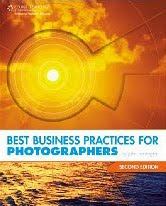
Full Review: Best Business Practices for Photographers

UPDATE: Harrington has just released the second edition of Best Business Practices for Photographers. And at 523 pages, it has nearly half again more information than does the first edition. In addition to being the standard photo business book of this generation, it has evolved to include a significant amount of timely new information.
Added to the second edition are insights such as how to transition from newspaper shooter to freelance, how to wade through the new electronic copyright filing system, how and when to file DMCA notices -- and how to wade through and survive a full I.R.S. audit.

Normally when talking about a book, you compare it to other books in the genre. In this case, I know of no worthy peers to against which to measure this book. It is THE source for all things business when it comes to being a professional photographer.

It is written within the framework of U.S. law and business practices. But there is so much information there that people working outside of the U.S. will find it exceptionally useful, too.

If you are a professional photographer, or are contemplating becoming one, get this book. At less than $25, it is an absolute steal.

Think of it as ... stupidity insurance. My suggestion: Go to Amazon via the link above and use the "look inside the book" feature to browse it.

Even if you do not agree with everything it has to offer, you would be nuts to work without it as a reference. It has become the compass point for a generation of photographers, and it will get much use from any pro shooter.


David Hobby
October, 2009

__________


(What follows is the previous review material from the first edition.)


I finally got a chance to finish John Harrington's new book, Best Business Practices for Photographers. What follows is the full review I promised when I first wrote about it.

Is This Book for You?

Here's the short version. If any of the following describes you, you want this book:

• Full-time professional photographer
• Part-time professional photographer
• Someone considering making the leap to turning pro
• Anyone who wants to know how a successful pro shooter operates

If you are an amateur, are happy being one and will always be one, this book is not for you.

If you are a professional photographer who is already an expert in business, hiring, pricing, overhead, accounting, all forms of contracts, negotiations, copyright, infringement of copyright (and how to remedy it,) handling slow- or no-pay clients, writing business letters, using an attorney, storage, archiving, digital asset management, stock, the care and feeding of clients, ongoing education and balancing photo/family life, you might not need to spend $23 on this book.

But my guess is, John has something to teach you.


What's In the Book?

Here is a hard fact:

Most photographers who fail do so not based on their photographic skills, but because of a lack of business acumen. And for many working shooters, a working knowledge of what is in this book will be the thin line between making it -- and not.

Best Business Practices for Photographers the whole business playbook, from both the strategic and tactical points of view.

The first thing he does is to teach you how to think of yourself as a business. Which you'd darn well better learn how to do, ASAP. He gets into equipment and the planning and logistics of a shoot right off the bat.

From there, he's off to financial and personnel considerations - from assistants, employees and contractors (and the pros and cons of each) to how to price your work to stay in business. Again and again, he is about strategizing for the long haul. Do you even think about overhead?

I would wager that most photographers who ultimately fail did not think about things like that until it was too late.

You need to learn about your business costs as well as the salary - yes, salary - that you will be paying yourself. Fail to consider either, and it's game over for your photo career.

This book is a reference for photogs wanting the basics on insurance, accounting and legal info, too. And legal info is one of the areas where the book shines.

John goes so far as to include a variety of actual contracts for you to read and educate yourself. If you have been a long-time Strobist reader, you know that I am all about "no secrets." And John is there, too. In spades.

He really expands on the contracts. They do exist for your protection, you know. He has chapters on contracts for editorial clients, corporate clients - even weddings and other rites of passage. These are hard-won documents born of costly mistakes. They are there to give you a free pass on those mistakes.

(Don't worry, you'll probably invent completely new mistakes on your own. But at least you can skip the ones John endured for you.)

And speaking of no secrets, he also includes long threads of actual e-mail exchanges between himself and his clients on a variety of subjects. What an idea. The names are redacted, of course. But the point is he shows you exactly how he does this stuff. And how they respond. And what he said next. And so on.

From a no-holds-barred perspective, this book bares it all. You're crawling around inside the guy's brain.

He spends a lot of time on copyright, infringement, and the theoretical vs. practical remedies to the latter. That's critical info to a content producer.

Look, I know many of you eat and drink this photo stuff. You look at pictures all day long. You are gear wonks. You crave the next "fix" of making a really hot image.

But if you are gonna do this for a living, this guy is a Photo Business Rock Star, and he is laying his oversized brain bare to the world. For twenty frickin' dollars.

I cannot put it any more blunt than this:

If you follow his roadmap and still fail, you can take comfort in knowing it was probably because you sucked as a photographer. Because this book has the biz stuff covered.


-DH


Best Business Practices, by John Harrington, is published by Course Technology. The list price is USD $34.99, but it is available at Amazon for about $23.

Wednesday, October 25, 2006

Lighting Boot Camp: Continued

Are you in Lighting Boot Camp withdrawal?

The Strobist main-site version was a one-time, summertime affair. While it attracted a wide variety of participants, it was also very time intensive for one person to run. And there are many projects in the works at this point for this site that force me to choose where to deploy my time resources.

(Unless one of you wants to hire me to do this stuff full-time, of course...)

But if you are jonesing for more participatory lighting stuff, fear not. There is an ad hoc continuation of the ongoing lighting school concept happening in the Strobist Flickr group discussion board. They are calling it the "Strobist Challenge."

It will be what you make it. And of course, the more participants the merrier.

On a related note, I will be looking through the pool entries on a weekly basis for a reader photo of the week. And photos from the Strobist Challenge will definitely be in the pool for consideration.

The best way to learn this stuff - there is no other way, actually - is to do it.

Tuesday, October 24, 2006

So, Think You're a Hot Shot?

Are you crankin' those new off-camera flash skills?

Yes you are, by the looks of the stuff in the Strobist Flickr pool.

Strobist reader Pieter Pieterse sure is. That's his firey match photo - click on it for more info.

Starting Friday, and hopefully continuing each week, I'll be looking for a reader photo to showcase. I'll look through the last week's pool entries and pick something that really stands out. (To me, anyway.)

After all, if you make a hot photo, who better to show it to than 10,000 other photographers?

Sunday, October 22, 2006

Luke, I'm Your Flasher...

Want a ready-made fall model for your growing lighting skills?

Shoot your kid(s) in their Halloween costume. That's exactly what Strobist reader Resuggan did while playing with one, small flash.

He put it to camera right on 1/8 power manual, stuck a red gel on it and triggered it with a PC cord. The kicker that pulled off the idea was to use a time exposure to track the toy lightsaber as it moved around a bit.

Tres Hollywood, IMO. Click on the pic to see it bigger.

If you are not a member of Flickr's Strobist group yet, you should be.

And just to make it easier, take advantage of the Strobist Halloween special and join Flickr for free...

Pop-up warm-up

In the new Photo Tips column on Arizona Highways Magazine Richard Maack, Photography Editor describes superglueing a little 1/4 CTO (Color Temperature Orange) gel to the pop up flash on his Canon 20D warm the light.

By Mike H.

Thursday, October 19, 2006

Fourth and Long? Drop Back and Punt with a Plant.

A couple of weeks ago I was shooting a restaurant review of a joint that specializes in cuisine from the Dominican Republic. It has, well, homey decor. Which suits the cuisine just fine, of course.

But I just could not make the room translate into a photo with enough impact to carry a food review. I was trying to say "tropical," but all I kept getting was "cafeteria."

The lighting was mixed. And not in a photographically cool way, either. Tungstens and fluorescents were everywhere. Throw in some daylight for good measure.

The back walls were dark. And the the one wall that could have carried a clean shooting angle was completely covered by a mural that was too loosely composed to work well as a background.

Welcome to my world.
Normally, I would have defaulted to shooting the building front and a (well-lit) food close-up. But they needed a couple of photos and the facade had me shooting right into telephone wires (and the sun) with no time to re-sked.

First thing I did was to use the fluorescent-neutralizing switch, which left me with a more useable combo of tungsten and daylight.

(What, your camera doesn't have a switch for that? Of course it doesn't. The fluorescent neutralizing switch is on the wall...)

Then I reached into my trusty bag of tricks.

Every photographer should have a bag of tricks. The point is to use each trick very infrequently, so they are fresh and ready to pull out when you need them. So, you'll want a big bag of tricks.

Otherwise it is more of a cliche. Or a crutch.

(Hey, I know this cool lighting website...)

One of my favorite tricks is using a plant as a "cookie" to add a layer of interest to a photo.

Cookie, in this case, is short for "kookaloris," which is genuine photo jargon. It is generally a piece of black cardboard with a pattern of holes in it that you shoot a light through to get a cool pattern on a background.

The problems with hole-patterned cardboard are (a) it looks a little hokey to me, and (b) I usually do not have one one me.

And I could generally live with "A," if "B" were not a problem.

But there's almost always a plant. And plants make great cookies.

In this case, the plant was a palm, which would work great to cast a shadow that could subtly add an appropriately tropical feel to a photo.

And I needed tropical.

I decided to strip the lead image to the bare essentials - table, chairs, a vase of flowers and the pattern created by the light through the plant.

And for you PJ types, I did not arrange the furniture for the shoot. It is found, with added light.

And speaking of the ethics of adding light: If the plant idea worries you, you are already a little bit ethically pregnant when you light something. It is a restaurant/food shoot. I can live with a cool shadow just as well as cool light.

The result is what you see at top. When I am aiming for elegance, simplicity with a twist is usually the easiest route for me.
Here is the wide, tell-all shot. See how ridiculously easy this is?

Yes, you do.

From this photo, you should also see where my fill is coming from - the ceiling. I could have reduced (or eliminated) the fill be snooting or gridding the flash.

Here are some tips for the next time you are in a visual bind and you need to bake a cookie to get you out of it.

1) Find a plant. (Duh.) Or you can use a window. Bonus for finding one with blinds. But plants rock for this.

2) Use a small light source. I am talking about the size of the actual flash head here, not the power of the light. You want to project with some sharpness. Speedlights are ideal.

3) Snoot your flash (or at least zoom it out) for light beam-width control.

4) Wanna know where the highlights will be? Eyeball your projection surface from the point of the flash. With apologies to Stephen Hawking, light usually travels in a straight line. If you can see it, it'll get direct light. You don't need no stinking modeling lights.

5) You gonna shoot a person in this light? Why, yes, that is a very good idea... Make sure they can see the flash. Then the highlights will be hitting their eyes.

6) Also, for a person, you might wanna use a Sto-Fen (or small tupperware equivalent) to bounce some of the light off of the ceiling at the same time with the one source. That'll be your fill. Of course, you can do it with a powered-down second light, too.

And who's to say that this is your main light? Get enough space to light on two different planes. Think soft main light very close to the subject, who is far away from the background. This can be the back end of a killer, two-light setup.

So, next time you are in trouble, stick a plant between your light and a boring picture.

It'll make a true be-leaf-er out of you.

(Editor's note: I can make an atrocious pun like that because I am running out the door to safety en route to a four-day weekend in the mountains of Western Maryland. By the time I get back next week, you'll have forgotten all about it.)


Next: Shade is Your Friend

Share

Twitter Delicious Facebook Digg Stumbleupon Favorites More