Thursday, November 16, 2006

More Grecco: Martin Scorsese Time-Lapse


It is not often you pick up a watershed tip from a BTS vid, but this Michael Grecco time lapse of a Martin Scorsese shoot was just that for me. The tip is all about using a grid spot to selectively compress the tonal range of a subject. And in this case the black overcoat being worn by Scorsese does not stand a prayer of reproducing any texture -- until Grecco fixes it.

He underexposes the ambient and lights Scorsese from camera right with a warmed-up softbox. Nothing new there. But at camera left, there is a low-and-tight grid-spot flash that is there solely to bring up detail in Scorsese's black coat and give dimension to the crates at the bottom.

That's great attention to detail (no pun intended.) It brings the coat well into the reproduction range, and gives tone and texture where there would be none. The photo would look fine without it, frankly. But that's a good example of the nuanced thinking that separates the Greccos of the world from the other guys.

He inserts several finished still photos in at the appropriate times. Pause it and check out the coat to see what I am talking about.

Merry Christmas to Me

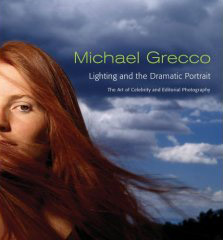
I cannot tell you how hard it was to not just click the "Buy it Now" button and snag Michael Grecco's new book, Lighting and the Dynamic Portrait, off of Amazon tonight.

I mean, less than $20? No brainer.

Why didn't I?

Because I am a dad. And dads need things on their Christmas list that fit within very modest budgets. Besides, knowing there is a good chance that Santa will leave this under my tree will make anticipating Christmas that much nicer.

(And if I do not get it for Christmas - so help me - I will have the thing ordered before the last piece of wrapping paper hits the ground. Next day shipping, too. A man's patience only stretches so far...)

Why am I this excited?

First, and no offense to many "how-to-shoot-portraits" authors out there, but it is rare to have a book written by someone who (a) is widely respected for being among the best in his field, and (b) knows how to communicate his thought process.

Michael Grecco is one of the most dynamic and versatile guys working in the portrait genre today - and has been for a while. Don't believe me? Check out his website. And don't miss his downloadable advertising and entertainment portrait portfolios.

If he is generous enough to dish up his considerable knowledge for nearly 200 pages under $30 (under $20 at Amazon) well, I am gonna be right there with a portrait of Andrew Jackson in my grubby little hands for him.

He did another book, but it is out of print and goes for over $100 in the used market.

Don't just take my word for it. Here's one of his Amazon reviewers:

"Don't read it cover-to-cover. Just flip though this book and stop at the first picture that grabs you. Grecco is that rare photographer who can actually put into words the creative process behind his images. He is smart, honest, funny, and frank about what it takes to make the beautiful, unique, and skillfully executed portraits that lavishly illustrate this book. There is a wealth of detailed, specific information about how the photographs were created (lighting diagrams, actual cameras, lenses, and lights used, etc.), however, most valuable is his emphasis on WHY he made his various creative and technical decisions.

This volume would be worthwhile for the pictures alone, or for the diagrams, the behind-the-scenes anecdotes, or just for the insights into the technical, practical, strategic, interpersonal, and financial components that contribute to the successful outcome of what is typically thought of as a simply artistic endeavor. Rather than regarding it as a book of recipes to be rigorously replicated, he suggests using it as a jumping-off point; as an opportunity to facilitate and fine-tune your own creative process."

And who is the reviewer?

Nobody special. Just, uh, Gregory Heisler, whose nose I am not worthy to pick. Who has more lighting knowledge in his pinky than I will ever have in my greying head. Who I really wish would follow through on his threat to do a book of his own.

(Go, right now, and check out Heisler's site, along with Grecco's. Go on. Do it now.)

I cannot wait to read Grecco's book. But I have to.

Thanks much to Strobist reader David Higginbotham for the heads-up.

Wednesday, November 15, 2006

Behold: A Light... With a Diffusion Panel.

Strobist reader X-Pose has posted a neat little tutorial showing how he made his DIY PVC light panels. Better yet, he shows how he uses them to light his Christmas card photo, too.

FYI, I am working on a pretty in-depth multimedia project for Strobist that will show many really cool things that can be done with these easy-to-make panels. They are a natural fit for speedlight users.

But you'll definitely want to check out what X-Pose has going on, too.

And while you are at it, a little thinking exercise:

How could he have done the whole thing - diffused light source and "cookied" trees - with just one flash?

Yak about it here.

Tuesday, November 14, 2006

Sometimes it's Not the Photo, it's the Process

On some photos, you take satisfaction not so much from the photo itself but from the process that got you to it. Such was the case a couple of weeks ago, when I was assigned to shoot an up-and-coming rap artist in Baltimore.

I arrive at his house a couple of minutes early for the assignment as he is finishing up the interview with the reporter. He tells me he is very tight for time, and offers to e-mail the paper a handout photo in lieu of the assigned photo.

Well, my editors are not exactly gonna like that, I think. So my first thought is to come up with an idea that I can pull off quickly.

To make matters worse, after talking for a few minutes with the guy I get the feeling he is just not really into being photographed on this particular day.

Alrighty, then. Time for Plan B.

At this point, you have to recognize a decaying situation for what it is and circle the wagons a little. You have to remind your subject how, with just a little time, you can work together to make something that looks cool and unique. I tell him I brought lights - I always have lights - and have a good idea for a photo in his home studio.

This much is true. I always try to preconceive a photo if for no other reason than to have a foundation on which to improvise.

Turns out he is not interested in having a shot done in the home studio. So I backpedal a little more and find out what he might be interested in doing.

Mind you, all of this is happening in real-time, over the span of about 30 seconds. I don't want to lose this guy. But I do not want to come back with a lame photo, either.

Parked outside the rapper's house is a conversion van on which he has painted with his logo and the logo of Virgin Records, who has recently signed him to a recording contract.

The van is not my first choice for a photo. Or my second or third, for that matter. But it is clear that it is somewhat of a point of pride for the guy. So I do not resist when he repeatedly steers the conversation to it as a possible backdrop.

(Hey, at least we are talking about actually shooting a photo at this point.)

So I tell him to go ahead and get ready to leave, and to meet me outside at his van in five minutes for about a two-minute shoot.

Now all I have to do is to come up with an idea (and a way to light it, and to set up the lights) in 5 minutes.

No prob.

First step is to put your lights, stands and syncs together in one fell swoop. While you are doing this, you assess the scene and try to visualize a finished photo.

The van is black, so I decide to go with a dark key for the photo. Luckily, it's cloudy, which gives me more light ratio options on the small flashes. Thank goodness for that, at least.

I quickly decide on something overly-lit and a little theatrical. I am going to shoot him leaning against the van and light him from two directions.

The strongest light - and the one that will determine the look of the photo - will be a direct backlight. I decide to use direct flash, (a Nikon SB-800) on full power, with a CTO gel for color separation.

So, I set that light up and pop a test shot at 1/250th (max sync speed) to see where me ambient ends up with the very small aperture (f/16, I think) that the full-power flash gave me.

Remember, the flash is aiming back at me, so I shield the light with my hand for the test shot. The ambient goes to darn-near black while the light rims my hand and lights the van at the same time. Great. I have all of the lighting control that I need.

Now to light the front of him.

With my working aperture at f/16, I bring another manual flash (a Nikon SB-24) in from upper camera right. This one is set to 1/4 power, which is what it took to light my hand to the correct exposure using the already established exposure of f/16 @ 1/250th. Again, a couple of test pop verified it. After a while, you get pretty close on the first try, then you fine-tune it with a shot or two.

I set the flash zoom setting on 105mm, to control the beam spread of the light. Now, by aiming the flash a little high, I can get a nice falloff on the bottom of the guy and seal off the photo a little with the darkened bottom.

Here's the setup:


And here he comes, right on cue, walkin' fast and lookin' late.

But I have him all ready to go. One quick test confirms that my exposure is on target. (If it wasn't, a quick adjust and another test shot, and I'd be in business.)

I then shoot about 20 frames, so I am covered if the guy really has to bolt. But I want to get a little more time out of him to try two or three variation.

Here's one of my favorite tricks for squeezing a little more time out of a subject.

Up until now, my demeanor has been one of efficient professionalism: Shoot quick. "Look this way." Got it, thank you. "Chin up a little." Thank you. Etc.

To try for the extra time, I stop and make a point of taking a look at the back of the camera.

Now, all of the sudden, I am "surprised" by how well this is turning out. (Not really - I knew exactly what I was gonna get. But he didn't.)

"Cool! Check this out - this looks great!" I tell him.

Of course, he'll wanna look. It's a photo of him. Yeah, it does look good, he agrees.

(I mean, how could it not, with such fine raw material to work with, right?)

And, in an instant, here's the deal as it now exists:

If he loves it, he'll almost certainly find a few more minutes to keep shooting. Why short-change the viewing public, after all?

If he hates it, he'll show you with his expression. Even if he lies and says it's okay. Just ask him what is bothering him, and introduce a variation to fix it with a few more minutes' shooting time.

He's not editing you - you already have what you were gonna get in the can. But you are bringing him into the portrait process in exchange for what is almost certainly going to yield more shooting time.

I have had five-minute corporate CEO shoots turn into 30-minute sessions this way.

They all want to look good.


In this case, I got a few extra minutes to play with different shutter speeds and try some flash-drag-camera-jerk stuff.

I preferred the original setup, and we went with that.

But the important point is that I went from "sorry, no photos today please," to multiple shooting setups, lit for effect and quickly produced - with variations on the visual theme as a bonus.

It's not enough to know how to light. You need to have a selection of techniques that you already know, and can go to quickly. And that includes setup time.

But beyond that, you need to cultivate the interpersonal skills to bring someone along (while you quietly panic on the inside) and work to make something out of nothing.

Always remember that for most people, the thought of being photographed - especially for publication - is a bit of a head rush. Sometimes you have to use that, and appeal to the person's ego, to overcome the natural shyness and self-consciousness that we all have to some degree.

And if you can do it quickly and smoothly, that's just bonus points for you.

Next: Zebra Fish and Zygotes
Updater on the Canon Flash Mods

Michael Bass has set up a website describing, among other things, his Canon flash sync sub-mini jack mods.

They have been well-received by Strobist readers, and will (hopefully) prompt Canon to include a PC sync on future flash models.

Anyway, he is no longer confined to eBay. Check out his page if you get a chance.

Monday, November 13, 2006

Apparently, The Books are Way Better

First of all, thanks much to those of you who were actually taking up a collection to fund a sub to Commercial Photo magazine for yours truly. That kind of thoughtfulness is much appreciated, but not necessary. Yeah, it looks great. But $300 is a lotta ball bungees. if you know what I mean.

I am actually looking for a Strobist reader budget-friendly alternative, and it looks as if someone may have found it.

Got some info from Strobist reader Jon, and I am passing it along in what I promise will be the last post about Commercial Photo.

(At least for a while.)
"... Commercial Photo is a great magazine, but I don't think the pages on lighting setups you may have seen are representative of the magazine as a whole, and this might have a bearing on whether you wish to spend $300 on a subscription.

Unless the magazine has changed since I left Japan a year ago, only a very small section is dedicated to a detailed breakdown of a photo shoot. The overwhelming majority of the magazine will be unintelligible to anyone who can't read Japanese, although it usually has some decent photos to peruse (although there are much better magazines for that purpose such as 'Phat Photo' and 'Dejitaru Shashin Seikatsu"). In short, a $300 subscription may not be the best value for money.

What might be, is the Commercial Photo Series set of books published by the same company. These books are about 150 pages long, cost 2,340 yen (c.£10/$20) each, and 90% of that is strictly photos and lighting diagrams. I've included some links to photos from their fashion photography edition. ..."

Check Jon's Flickr stream for some page grabs. Apparently the books are pretty much non-stop pix and lighting diagrams. I have done some looking, but have not found a source for the books in English/$US.

Any ideas? Post 'em in the comments section.

And click on the pic for a selection of the books at an auto-translated page.

OT: I Want One.

Not gonna get one. But boy, are they cool.

I'm talking about the Segway HT, which I got to play with for four hours yesterday on a tour of Washington, D.C.

Yeah, $4,000.00 is a chunk of change. But for $70, we got to have a lot of fun. And I think I have gotten the Segway jonesin' out of my system. Maybe.

They have branches in six other cities. Highly recommended as a gift for a loved one. Or for yourself.

Share

Twitter Delicious Facebook Digg Stumbleupon Favorites More