Thursday, May 4, 2006

Choices: External Power Sources

You use a few 60-watt-second strobes long enough, and you are going to start to wonder about alternatives to AA batteries. The very thing that makes the flashes attractive - small size and light weight - also limits their power output, recycle time and number of flashes.

Here's the normal track for most shooters:

You start with AA's, of course. Then you want more total flash capacity, so you buy a Quantum QB1+ battery, because it costs less than the high-voltage stuff.

But since it is only a 6-volt system, so you gain no advantage on recycle time. And you are still carrying around the extra weight.

After a while, you start to resent the fact that you are carrying around the extra weight without the extra recycle speed, so you buy a hi-voltage battery and you wonder why you didn't do that in the first place.

And yes, I know there are some cool other 6-volt systems out there, too. Some garage engineer is always introducing a new 6-volt rechargeable batt. But again, it comes back to this: If you are gonna carry around the weight, you may as well bite the bullet and get the super-fast manual recycle times. They make the flashes far more versatile.

Here's the thing. The plain old AA batts are a really pretty good deal, when it comes down to it. If you work for a paper, they are normal supplies. If not, you can get them for about 20 cents each in bulk at Wal-Mart or Home Depot. They have a bad rap, if you ask me.

The Ni-MH rechargeables are okay, but they run at 1.2 volts each instead of 1.5 for alkalines. So recycle time is further hurt, and the flash thinks the batts have worn out before they actually are.

EDIT: Points taken (from the comments section) on the Ni-MH batts. They seem to be a very good choice if high-speed recycle is not important. And the batteries definitely are environment friendly, which a big plus. They are also easier on the wallet in the long term.

Apparently there is another Nikon batt pack that uses them, too, as per another comment. Although I do not know how it fits so many different SB's, some of which have different Hi-V connectors. More info would be appreciated.

Thanks much for the input, guys. And if you are not reading the comments, you are missing out on lotsa good info...


If I had it to do all over again - and it is a constant lament that I don't - I would have bypassed the heavy-duty 6-volt external packs and just used AA's for most of the time. If you are gonna be shooting a lot, stick another 4-pack of fresh batts in your pocket or waist pack. Easy, lightweight and cheap.

(You wedding guys are a different breed, of course. You need capacity, and lots of it. Quantum QB1+ battery packs may well be the best economical choice for you.)

Even now, most of the time I use AA's. I use hard light more and more these days, so I tend to hang out in the 1/16th to 1/4th power range on manual. But when I light sports - like wrestling, or hoops - I go with two high-voltage packs.

This is one reason I look for strobes that have a jack to accept a high-voltage battery pack. Having the ability to get a one-second recycle at full manual power is a great thing. (Most of the Nikon SB bounce flashes have high-voltage jacks.)

Here is my setup. I have 6 SB-style strobes (kind of like Mrs. Strobist and shoes, I guess) but only two high-voltage packs. The kind I use are ten years old and made by Lumedyne. I absolutely love them. They cost less than the Quantum Turbos. They take the beating of rattling around in my trunk. And they just go and go and go.

The current model, the Lumedyne High Voltage HV UltraCycler, is a little dressier than mine are, but the guts are mostly the same. There is a better "remaining power" meter, too. If the rechargeable batteries ever wear out, Lumedyne will rebuild them for much less than the cost of a new pack. And the batts they use in there are so good there is an 8-year, pro-rated warranty.

You'll need to get a cord to fit your flash. The connections are the same as the Quantum Turbo cords, so you can search both areas for the cord to fit your flash. But this is money well-spent that will will benefit you for years and years to come.

Much like the Pocket Wizards, you'll eventually want one of these. Hopefully, it'll be before you spend an equal amount of money going through 6-volt systems and accessories. You are probably only going to need one, even if you use multi-light setups. One light is usually doing your heavy lifting, set on full or half power for bouncing into an umbrella or ceiling. So you stick the Lumy on that flash and use AA's on the lower powered one(s).

The only exception is cross lighting basketball from the up in the stands. You'll need two batts (and Pocket Wizards) to do that effectively. Yeah, I know it is expensive. But that same setup will serve you well through all of your cool, lit environmental portraits, too.

And for you Canon shooters (who shoot with those neutered, PC-less Canon strobes) it's payback time. You have a great option. The CP-E3 compact battery pack uses AA's, Ni-Cad's, Ni-MH's, whatever. It is small and light and even comes with a cord to fit your flash for about $135. Full-manual recycle times are less than 2 seconds. Make sure it is compatible with your model. If you are going to use Canon strobes, I'd grab one (or two) of those and some Ni-MH AA's while you are there (or grab them from Wal-Mart.)

Nikon makes a similar setup. But it only fits a few of their flashes. If you shoot with SB-800's or SB-80DX's, you are in luck.
Wednesday, May 3, 2006

It's Easy, Being Green...

UPDATE: One free sample pack request? Cool. Legions of free sample pack requests? Not so much. The page at Rosco linked to by this post has been removed. And I am pretty sure we killed it. Oops.
______

Hey, folks-

Here's a quick link to request a Rosco "swatch book," which contains a single, shoe-mount-flash-sized sample of just about every gel Rosco makes. (It's about 2 inches thick!)

If you are going to use them on your strobes, you simply need to extend the size a little by sandwiching some tape onto the edges. The gel itself will cover your shoe-mount strobe face just fine, but it has to have some extra length created to have space to fasten it with the velcro technique discussed on the "how-to gel" page.

This'll get you started even if you are penniless on a student budget. And don't worry that you are freeloading. You will be purchasing some of the 24" x 20" sheets at $6.95 a pop before it's over.

New to the gel thing? Get more info on this how-to page, from the Lighting 101 section.

-30-

Great (and Free) Idea: Keep a "Lighting File"

If you have worked your way through the Lighting 101 and/or On Assignment sections, you should be getting to the point where there are few lit photos that you can't reverse engineer.

Heck, we even did a page on this, which reminds me that I should update and expand it now that I am not writing through the haze of the Please-Let-Me-Die Flu.

The idea a Lighting File is similar to the technique Mrs. Strobist uses to keep track of examples she sees of cool kitchens and (potentially) great haircuts.

While I am not one to equate mere lighting design with epic, critical decisions such as kitchen remodeling and haircut choice (just in case you are reading this, honey) the concept is a good one.

In practice, it is very simple. Any time I see a photo in which great light was created, I try to keep it in a file for later use.

If the idea is in a magazine that is (eventually) bound for the trash recycling bin, simply tear it out. One should get permission, of course. (Or develop a sufficiently noisy cough to mask the sound...)

If the idea is a reproduction of an Old Master's painting in a valuable manuscript in your college library, that's a different story. Maybe jot some ideas down. It's hard to light stuff from jail.

Keep a rolling list of visual ideas in a folder or envelope in one of the slots in your laptop bag and you may be surprised at how organic and serendipitous the lighting idea process will become.

Ditto the web sites of great photographers. On a Mac at least, you can save anything in a web window by simply "printing" it to your hard drive as a .pdf file. Keep a folder full of cool stuff for inspiration when you need it.

For example, I keep a file of California-based photog Tim Tadder's work. He is really doing some edgy stuff with light lately, and I have been experimenting with a "wrap-around" look similar to what he does with several of the photos on his site.

As an aside, just 10 years ago this guy was a college puke following one of my colleagues around, soaking up knowledge. Now, he is out there cranking some top-notch stuff.

For me, this is inspirational on a couple of levels.

First, he is doing some crankin' light. And second, Tim is a great example of getting off of his butt and just diving right into his work and technique.

Note that I am using the term "inspire," and not "rip off." The idea is not to ape someone, but to look to their style as a new venue you can explore and meld into your own vision.

The difference is important.

Anyhow, keeping Tim as an example, I am trying to create a sort-of wrap-around look with two or three cheap, small strobes.

I already have one attempt under my belt, and I will throw up a full write-up after it runs in the paper on May 10th.

I gave the first effort an overall "B-," meaning the concept will absolutely work, but I have some work to do on the execution. This is normal, and not to be interpreted as a failure. I will keep working at it, tweaking the light to be more subtle and remembering to have more to the picture (content and motion) than just cool light.

My first shot at it had the subtlety of Mike Tyson. In addition to toning it down a bit, I should worked more (uh, as in some) content into the photos. But I was using three lights in a tight zone. And one of them was the sun, which was moving in and out of the clouds. (That's my first-timer's excuse, and I'm sticking with it.)

I keep a file with me most of the time, because I am always combining ideas and techniques on assignment. If I have 20 minutes before heading to a portrait assignment, I might drop by a magazine stand on the way there. Or, better yet, a music store. You get the idea.

Visual stimulation is everywhere.

Immerse yourself in it, and keep a journal. You'll be glad you did.
__________


Congratulations! You Made it Through Lighting 101.

If this has whetted your appetite to learn more about lighting techniques, you'll want to visit Lighting 102 or On Assignment for the more in-depth stuff.

So, where to next? Lighting 102, or On Assignment? (I'd suggest taking a break and perusing some On Assignments. See if this stuff is starting to make sense in real-world settings...)

Tuesday, May 2, 2006

Psst... Wanna Buy a Flash, Cheap?

Get 'em while they're hot:

Retail photo gear bohemoth Adorama apparently has a stash of used Nikon SB-24 strobes in stock, with some going for as little as $45. Yeah, it's probably a fugly one, but still - that's a steal. There's also an "excellent" condition (whatever that means) one for $54, if you are the shallow type who puts high value on appearances (and, thus, would never give me the time of day in high school.)

To go straight to the stash, click here. If you do not know why SB-24's are a bah-gain, click here to learn more.

For you foreigner-types who can't use eBay, this is a good chance to grab one.

Monday, May 1, 2006

On Assignment: Make the Ambient Work For You

As you get used to using light on your assignments, you may find that you start to change your thinking when it comes to the ambient light sources that you used to have to rely upon.

Raising the level of light artificially with strobe has the effect of lowering the relative intensity of the pre-existing light in the scene.

While this tends to solve some of your bad-quality-of-light issues, it can also be an opportunity to use the ambient as a compositional element.

If you are just shooting with just the ambient, it is hard to include the light source in the frame. It will usually be blown out. This is because (unlike your eye) film or digital simply cannot hold that contrast range.

But if you have your subject cranked up a couple of stops (or more) with strobe, you compress the tonal range and may be able to use the existing light as a compositional element.

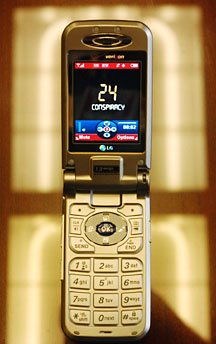
In the photo above, I was sent to Verizon's offices in our area to shoot an exec with one of their new "V-Cast" phones, which shows little TV show snippets.

They call them "mobisodes," which apparently sounds way cooler than "dinky little video clips."

I shot the obligatory Guy Holding The Phone shot, but also wanted to get a detail shot of the phone itself. There was not a lot of environment to work with - just a table in a room. I had lit the phone with an SB-28 on an umbrella, but I wanted a little more visual interest.

So I decided to include the florescent light fixtures reflecting in the tabletop as a compositional element. They aren't the end-all, but it is a matter of working with what you have.

Since I had the phone lit to f/11 by the flash (from camera right) and filled by a sheet of paper (out of the frame at camera left) it was a simple matter to dial down the shutter speed until the florescents' reflection fell into the contrast range of my photo. It gives the photo a little more of a high-tech look, without being terribly obvious as to the source of the pattern. I also used the phone to hide my own reflection.

Fortunately, the phone's display screen fit within the tonal range, too. Otherwise, I would have had to bail on the idea.

I use this technique from time to time on portraits, too. Those florescent light fixtures that we love to hate when shooting all ambient can turn into cool, futuristic-looking repeating patterns when you shoot someone from a low angle and they are lit enough to help you bring the florescent lights down into your contrast range.

So, nothing earth shattering. Just two things to remember.

First, to look at common compositional elements from a different point of view. And second, to take advantage of the ability to shift the light level on your subject to pull formerly unavailable elements into the contrast range of your photo.


Next: Use a Second Light to Create Tension

Saturday, April 29, 2006

Lighting 101: It's Not (All) About Flash


Guess what? You made it all the way through Lighting 101. This is the last lesson.

And you are probably a little stoked about your new-found skills. You might even already be playing with your starter kit. (If not, you are totally ready to.)

So I am going to suggest something to you that may sound a little strange:

It's not about flash.

Photo-graphy is, literally, writing with light. That's what we do. And you have just enough flash and lighting knowledge right now to be pretty dangerous. Because your photos are going to look better, more polished, more professional, etc.

But don't make your your photography all about off-camera flash — or even all about light. It's also about content and moment and emotion and gesture and setting and, yes, light, But the point is that it is not all about light. And certainly, it's not all about flash.

I say this because since starting Strobist in 2006 I have seen literally thousands of talented (and otherwise perfectly normal) photographers become infatuated with their newfound lighting skills to the point where all they thought about was the light.

So off-camera flash is all they are paying attention to. Which is not good.

Lighting is a tool. And you are learning how to use it. At this point, you already have more education and training than the average photographer. And that's great.

But it is important to make your lighting knowledge light additive to your previous existence as a photographer and not a substitute for all of those other cool skills you used to bring to the table.

In other words, use your new and growing skills to nurture your own existing skills as a photographer. Don't let lighting take over and subsume your creative vision.

The very last thing I want to do is to kill that individuality you had before you got here. Just let lighting make it better.
__________


Also, take time to just look at light. I mean real, ambient light. Daylight. Industrial light. Blue hour light. Golden hour light. All kinds of light. Discover it. Study it. Wallow in it. And make sure you keep shooting with natural light, too.

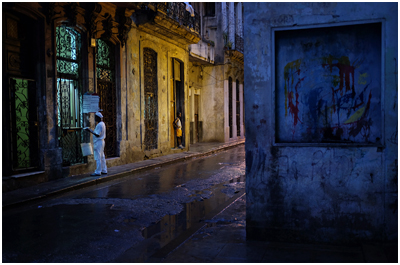
The photo at the top of this page, taken on my first night in Havana, is natural light. But I saw (and continue to see) it differently because I am a lighting photographer. There's a base-fill of blue-hour evening light, a couple of stops down. And the unseen hidden street light (at upper back right if that wall wasn't there) is very warm. And it's dominant over the blue — as far as it reaches anyway.

The the fluorescents coming from inside the building at left are just as rich and green as you'd expect fluorescents to be. And if you were creating this light (which you'll soon be able to do with a little practice) hopefully you'd have the sense and good grace not to "fix" those fluorescent lights. The green is beautiful in this context.

The palette in this picture works because it could literally be a painter's palette — some blue paint, some yellow, and a section of the two mixed together to make a goopy green.

And that's the point of observing and respecting and discovering beautiful light. Because any light you can see, or imagine, or remember can be created (or re-created) with flash. And that's freakin' awesome.
__________


One Last Thing...

Only one in ten people who start Lighting 101 actually finishes it. So good for you for sticking with it. And your persistence earns a little-known perk.

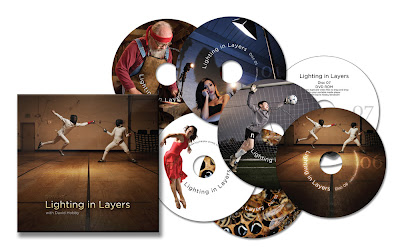
In 2011 I produced a 6(+1) DVD set entitled Lighting in Layers, currently in its 6th printing:


It's an immersive ride-along on several shoots of varying levels of difficulty and all lit with small flash. The DVDs are not for total beginners. But you are not a total beginner. Having completed L101, you know enough to dive into these if you want some more detailed and visual training.

They sell for $159.99, and you can get much more info (and a preview video) here. And as an L101 grad you can purchase the hard-copy DVD set, shipped free anywhere in the world, for USD $100 instead of the regular $159.99. Just order them from Midwest Photo and use the code "L101GRAD" (no quotes, please) at checkout.

And please, don't post this discount code. It's an "attaboy" (or -girl) just for the people who made it all the way through L101.

UPDATE: August 2013: If you are a member at Lynda.com, you already have access to the videos, here!


Thank You for Reading Lighting 101

I hope you enjoyed it, and learned a lot.

You have the basics that you need to be a lighting photographer now. And I also hope you'll join us regularly now to follow and participate in the ongoing conversation we are having about light. We're nearly 2,000 posts in now, and counting. And you certainly understand enough to follow along and learn more.

New posts go up once or twice a week. You can just show up (always welcome) or subscribe via email (we'll never spam you) or follow via RSS to keep up automatically.


Thanks for reading,
David Hobby

Thursday, April 27, 2006

Hook a Pocket Wizard to Any Hot-shoe Flash

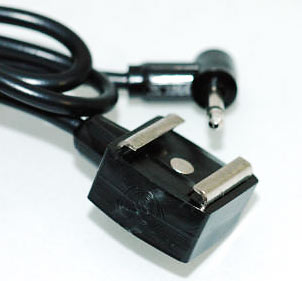
Two readers, Alan and Nick, have sent in this useful tip for anyone wanting to hook up a Pocket Wizard to a hot-shoe flash. Any hot-shoe flash. Even a Canon hot-shoe flash.

The PW-MHSF1 Miniphone to Hot Shoe Female cord connects the receiver directly to a hot-shoe on those PC-deprived Canon strobes. (You listening, Canon Honcho Chuck Westfall???)

They are $39 bucks and should get you a reliable connection. You could even make yourself a full synch cord using one, I'd expect.

Of course, if you scrounge a tad, you can probably find an SB-24 PC-enabled strobe for $39 to keep as an off-camera flash, (but I would never bring that up...)

Nick also suggested I mention Chimera strobe speedrings for softboxes, for when you wanna hook your little flash up inside a rectangular soft light. (I used softboxes so much in the 90's I have kind of turned on them. But that is just me. My left eye is starting to twitch a little just thinking about it...)

But Nick is right, and I will look into some small strobe mounting options for those light-sucking popular, versatile little light modifiers.

Thanks, Alan and Nick!

Share

Twitter Delicious Facebook Digg Stumbleupon Favorites More