As you might imagine, I have a lot of photos on my walls at home. Some of the photos (and the people who took them) are famous. And others are of my family or some of the places we have been.
My very favorite photo (not counting the ones of my kids - I
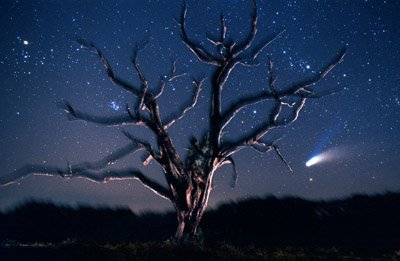
am a proud dad) is a wonderfully engineered shot of the Comet Hale-Bopp as it passed by the Earth in 1997. It was taken by John Moran, who was one of my early mentors when I was still a freshly minted photojournalist.
John was a very good general assignment photographer for the Gainesville Sun in Florida. But he excelled at dreaming up these spectacular feature photos that required months of advance thinking.
While he was shooting his daily grind of newspaper work, he would be arranging the details of a killer photo. Then it would show up, without warning, on the front of the Gainesville Sun one morning, prompting you to strongly consider getting into another line of work.
Like, say, plumbing.
Once he took a strobe out to an alligator-filled swamp at twilight, which made their eyes glow in a way made you consider your potential role as their dinner.
Another time, he made a multiple exposure of the sun's full track across the sky on the winter solstice.
And in 1997, he drove out to the countryside to shoot a picture of a comet. I am going to let him tell you in his own words how he did it. But first I want you to consider the exposure and light-balancing challenges he faced to pull it all onto one frame of Fujicolor 800 ASA 35mm film.
1) The background - which contains the very dim comet - is at about 5
minutes at f/2.8 at 800 ASA. And that's the bright part.
2) The background, from your Earthly perspective, appears to be slowly rotating. This rotation will come into play during your 5-minute exposure time.
3) The image will need a foreground element for added interest and depth. And that part happens to be darker than the background. So you'll need to light it.
And you are going to solve all of this with about $10 spent at the Home Depot. And a heckuva lot of ingenuity.
So, here's John, telling you how he did it. And then you can see the photo.
The World is a Miraculous Place: Comet Hale-Bopp, 1997 (
By John Moran)
Of all the interests we have in childhood, it's hard to know which we will carry forth into adulthood. Though astronomy was my earliest passion in life, I was soon to learn that math is the language of science, and that my love for the night sky would not sustain a career in astronomy. But I discovered photography at about that time, and was soon happily bumbling my way through some really awful nighttime pictures. The seeds were sown.
I cannot recall all the pictures I've made that reflect my early interest in astronomy, but I do recall vividly a picture I didn't make, a beautiful picture of Comet Hyakutake that was published nationwide in 1996. Distributed by the Associated Press, the photo by Johnny Horne of the Fayetteville (N.C.) Observer-Times, showed the comet drifting past the Big Dipper. I was impressed by its clarity and aesthetics, and I felt humbled by my lack of preparation to make a photo of this caliber. But the world of astronomy was already abuzz with the approach of Comet Hale-Bopp, and I resolved not to let the Big One get away. I had a year to prepare...
I wanted to make a picture of the comet that not only was beautiful, but was clearly grounded in the landscape of Florida. Among the many impressive natural features of this place we call home, live oaks -- dead or alive -- hold particular allure. I had just the right tree in mind for my picture. For a hundred years and counting, comets, eclipses, meteors and more have added drama to the night sky beneath which this ancient live oak has borne silent witness.
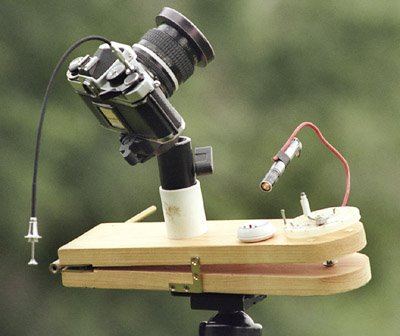
Deep-sky photography typically involves long time exposures with precisely guided instruments that track the apparent movement of the stars through the night sky. I consulted with astronomy professor Alex Smith at the University of Florida, with whom I had taken an introductory course twenty years earlier. He showed me a simple-but-effective tracking device he had made to photograph the return of Halley's Comet in 1986. I built my own, based on his design. Called a barn-door tracker, the gizmo consists of a pair of 1x4 boards joined with a hinge that is aligned to turn on axis with the rotation of the Earth. The rig is anchored to a tripod and the camera is mounted on a ballhead attached to the top board.
I replaced the hinge pin with a brass tube for sighting on the North Star, and by manually turning at 1 rpm a 1/4-20 thumbscrew offset 11-7/16" from the hinge pivot, the boards spread, moving the camera, slowly... The world is a miraculous place, and it was a beautiful experience sitting alone in the dark in the middle of nowhere with my little comet tracker, hand-cranking my camera in silent synchronicity with the Universe.
The photograph was made with a Nikon FE2 camera and 35mm lens on Fuji Super G 800 film. The exposure was 5 minutes at f/2.8. The tracking motion, while "freezing" the stars (and comet), creates a ghostly blur in the oak tree and the distant tree line. Radio-triggered strobes with amber gels cross-illuminate the tree. Two-and-a-half minutes into the exposure, a Nikon soft-focus filter was placed onto the lens, causing the celestial objects to glow around their central points of light.
Nice, huh?
Everybody needs good, early influences. I was very lucky to have John as one of mine.
He eventually left his newspaper staff job to follow his true calling and become a full-time, Florida-based nature photographer. You can see more of his work at
www.johnmoranphoto.com.
There, you'll find many different prints (including the
comet shot and the
alligator photo) which can be purchased.
He also has a book,
Journal of Light, if you would like to own more of his work.
All photos in this article © John Moran, 1997.
Next:
Test Driving the DIY Softbox Grid Spot