Thursday, January 4, 2007

Off and Running in this Multimedia Stuff

I was very pleased to find out today that the Fall project took second place in the NPPA national monthly contest for multimedia.

That's really cool and all. But in all honesty I am not that much of a contest hound. So to me the neat thing that came out of this was finding out about a new blog that is starting to keep tabs on all off the new media stuff.

Check out MultimediaShooter.com if you are into this kind of thing.

And if you are a PJ and you are not into this kind of thing, get ready to be left in the dust by your competition. Not to mention missing a great opportunity for layered storytelling. This is no fad.

The scribblers have had virtual ownership of the center of gravity in journalism for a long time. The next wave belongs to the PJs who are willing to step up to the plate and take some swings.

Tuesday, January 2, 2007

Bits and Pieces: Jan 3, 2007

• From the Flickr Strobist threads: Broncolor (the flash manufacturer) has a cool website that 'splains a lot about light and even lets you do apples-to-apples comparisons of different light modifiers. There's a lot of good stuff there, if you click around some.


• The little brown image ad on the sidebar is a month-long link exchange I am doing with the very surfworthy site, The Online Photographer.

We decided to introduce our readers to each other. The banner links to Mike Johnston's for-sale prints, but don't miss his blog, either. One of the best photo sites on the 'net.

Edit: Be advised that the T-O-P site has a small, (approx 1"x1") ad on the left sidebar that would not be considered work safe. Unless you work, say, in a topless bar. Just a heads-up.


• Pre-think this one along with me: Tomorrow my assignment is to do a series of macro shots of common snack foods. What would you do? How would you light it?

Do a little head-scratching, and compare your ideas to what I come up with for comparison. I will use only SB's, and will post my shots later as an On Assignment.

________________________________________________

EDIT: FWIW, I am not looking for ideas - I already have a few of those and will probably call a few audibles in the studio. It's more of an exercise in parallel thinking - of even shooting, if you like - to compare and contrast the final shots.

As an FYI on the technique, the closest thing I have to what I am gonna be doing is probably John Dohrn's cool bug shots.

But hopefully, my subjects will be a tad more appetizing...

-DH

On Assignment: Hit for Average

In almost every way, this is an utterly unremarkable sports portrait. But it makes a good example to illustrate that having a minimal lighting setup with you at all times can help you maintain some semblance of a standard when the deck gets stacked against you.

That's exactly what happened a couple of months ago when I made this shot of a prep soccer star who was closing in on a record for the number of goals scored.

There are days when you wake up and try to decide if you should call in sick, and there are days when you know you should call in sick. This day was one of the latter. But we are also short-staffed at The Sun, so calling in sick can sometimes turn into the starting point in a negotiation.

Unfortunately, we had a heavy assignment load and the desk guy said it would really help out a lot if I could spend most of the day in bed and then pop down to Laurel, MD, to shoot the prep soccer portrait during practice. The assignment was a quick turnaround, and the girl was not going to be available for several days after this afternoon.

No prob. I'll crash in bed and then try to look healthy for 30 mins in the afternoon. Hey, it happens.

So I show up to shoot her during practice, except there is no outdoor practice. That's because it is raining cats and dogs. So now they are gonna do drills in a dimly lit gym, which means absolutely zero soccer ambiance.

I have the normal SB in my waistpack, with a stand and umbrella on my shoulder. This is pretty S-O-P, even when going to shoot a feature at a practice. You never know.

But now I have no action, and no environment. So we decide to call an audible and see if we can get access to a classroom. Classrooms are one of my favorite drop-back-and-punt locations because they all have chalkboards. And chalkboards are practically as good as seamless paper backdrops in my book.

They are even better in one way, which is that they can be quickly customized to add a layer of context. (Just add chalk.)

I confessed to being contagious to avoid shaking her hand and to allow her the chance to keep her distance enough to stay healthy for the state tournament. So we worked quickly, and at a safe distance for her. We put a tick mark on the board for each goal she had scored and stuck her in front of it.

Fancy? Nope.

Nuanced? Hardly.

But it got the conceptual point across using just about the last two brain cells I had to rub together that day.

Lining this kind of a shot up can be trickier than it looks, as chalkboards typically start at about waist height. So I put her on a chair and stood on one myself to line it all up.

The light is simple and straightforward - no rule breaking here. I just wanted to get in, get a decent shot, get out and get back in bed. I put the SB on a stand about 5 feet from her, firing into a double-fold umbrella, and PW'd it to the camera. The light is coming from camera left up high near the ceiling.

Same drill as always: Set the camera on the max sync speed and get to the right aperture (in this case, f/5.6, I think) by trial and error. I was on 1/4 power manual on the flash. Then adjust the shutter speed until it is a couple of stops below the ambient to get nice fill.

(If that makes no sense, then go back to Balancing Light in Lighting 101 for a refresher.)

I used my electrical fluorescent filter - turn off the overhead lights and work with the window light as the only ambient. Hey, I was not feeling ambitious.

A dozen exposures later and we were out of the room in less than five minutes total.

You could do this without the added light. But you would be at the mercy of the window location in the room, and the shot would lack any crispness and/or separation between the subject and backdrop. Since it doesn't have a whole lot going for it to begin with, at least the light gives it a little quality edge.

A few takeaways:


• Always having the small light (and modifiers) with you gives you options that can bail you out in a pinch.
• Some pictures do not have a whole lot going for them other than the crispness that light can add.
• A chalk board is a quick and easy, variable backdrop that is waiting for you at any school. Lots of possibilities here.
• If you use light regularly as a matter of course, it's nothing to quickly do a shot like this - even if you have a fever of 102. Repetition makes this stuff so easy as to be nearly automatic.


IMO, you are defined more by what you do on the low-end, day-to-day stuff than what you do in the unusual, high-yield assignments. Light can help you make a photo better. Or it can allow you to make something out of (almost) nothing.

The satisfaction taken from a shot like this is less about what it is than what it could have been - a shot of a soccer player in a gym, with absolutely zero visual connection to the main theme of the story.

Next: Always Look for a Detail

Friday, December 29, 2006

The Last POTW of 2006

Two-double-oh-six is about to go down in the record books, and we are closing it out with the final Picture of the Week.

Knowing that I would be crunched with preparations for covering the funeral of former President Ford, I had another photo all picked out and the post pre-written. Then William Duffy has to come along and drop the self-portrait seen above into the pool.

Absolutely killer light, composition and gaze. The photo is a bit of a rule breaker in that the backlight (the second of two speedlights) is placed on the highlight side of the subject. This gives a very three-dimensional look and makes the sweat pop.

Very cool shot, William.

If you haven't yet joined the Flickr Strobist group to show us your own hot shots, we've just passed 4,000 members. So jump in. It's free, and you are in excellent company.

I am knee-deep both in ongoing funeral coverage and shooting the class-of-the-NFL Baltimore Ravens this weekend. Oh, and I also drew New Year's Day duty. Yee-ha.

So this is definitely probably the last you'll hear from me until next year.

Happy New Year. See you in a well-lit 2007.

Thursday, December 28, 2006

Taking Chances, Classic Lighting and Hairballs: A Closer Look at the Grecco Book

UPDATE: Great news for tablet/phone/pod-toting photographers. Grecco's excellent LatDP is now available on a variety of tablet formats, here.
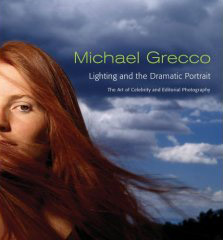
Having been a good boy this year (or, at least, not getting caught) I got a few things on my Christmas list. One of those items was Micheal Grecco's book, Lighting and the Dramatic Portrait.

I know that many of you are ahead of me on this one. And there has been a fairly spirited discussion on the book on the Flickr Strobist group.

But I have finally read the whole book (in chunks each night before going to bed since Christmas) and wanted to check in with my two cents worth on it. I'll start by saying what the book is not.

It's not a beginning lighting book. There isn't enough info on beginning lighting to start from zero and have a good sense of the technique and the craft. Ditto the info on cameras.

Unfortunately he kills fully a quarter quarter of the book speeding through these two topics. I suspect there was some arm-twisting from the publisher and/or editor, as this is clearly not the main thrust of the book. He gets through it quickly, with too much info for the experienced shooter and not enough for the beginner.

If you are looking for a general book on lighting, this should not be your first read. Maybe not even your second. That said, when he gets to his strength, the book really earns it's keep.

The main body of LATDP is, for me anyway, a treasure trove of info. I have already highlighted the bejesus out of my copy, and will probably make more notes on the second run-through.

Many of you have given glowing reports of the book. From others: Eh, not so much.

I think the book is refreshingly atypical in its approach, and wanted to report on what I have learned.

His main premise is one of learning - and then eschewing - the classic portrait lighting techniques. This is a view that I have been coming around to on my own over the last few years.

I look at it this way: Why go to the trouble to set up lights just to end up with a technically good, yet nauseatingly predictable photo?

I mean, do you ever walk into a place and see soft light coming in from twin 45-degree angles and think, man, that's a hot look?

Of course you don't. You notice edgy light. Back light. Beams. Spots, Mottled shadows doing cool things. That kind of stuff. So why is it that when we first dive into off-camera light, we go for well-exposed, classic, predictable, boring light?

That isn't the kind of light what stops us cold when we are paging through a magazine. But we sure do go to a lot of trouble (and expense) to make it.

I am as guilty as the next person. Well, more was as guilty as the next person. After all, it is "safe" light. And it does look very technically competent, for lack of a better word.

Having just described "Classic" portraiture lighting in the previous paragraph, here's what Grecco has to say about it:
"In most cases when I see this kind of lighting, I get a hairball in my throat. Not only of how predictable it is, but because of what it generally represents: slick, pedestrian lighting that is to me, schlocky!"

And how.

This guy does not just walk the walk, either. He goes on to break almost every lighting rule in the book. And if you think about this for a sec, how could you ever hope to stand out in a crowd without taking this approach?

Don't get me wrong. The crowd is a pretty safe place to be. For weddings, corporate shooting, events, etc - that's where the steady paychecks are.

Do I ever just bang out a classically lit portrait? Sure. All the time.

Why? Usually it is a time constraint - I know classic is safe, and I may not have the resources to go for multiple looks. Also, it frequently fits within the editorial mandate in that I do not want to inject too much vision into something and divert attention from the subject itself, which is the real story.

But more and more, I find myself tired/bored/impatient/downright angry with the idea of "expected" lighting. I think I am spending more time and energy taking chances with my light. And when I do I am generally happier with the result.

Grecco gives example after example of how he chooses to break the rules while on assignment.


One of my favorite examples - and so simple - is how he lit the NYPD Blue stars from the bottom with a hard light to get the upside shadows. (Click above to see bigger.) Then he gobo'd the light from the two guys' faces, then lit the faces from the top with gridded lights.

Well, of course. Why didn't I think of that? In a small setting, you end up with scener mood light coming from below and face light coming from above - both from the camera's horizontal axis.

That's not something you're just going to happen upon. That is the product of always looking for a way to break the rules and create a "look."

I really like the guy's problem solving, too. His is almost all location work, so he gets thrown a lot of curve balls. But Grecco can hit a curve.

Shooting a portrait of a man in a stainless steel freezer, he wraps the area in front of the freezer in seamless white background paper and throws his lights into that for smooth, gradient reflections. Then he shoots through a slit in the paper. But he's not done yet.

On top of that, he grids the guy's face, to pop it. Then, on the lights illuminating the freezer, setting he uses not one but several various shades of blue on the different flashes. This guy is going beyond using blue to connote "cold" and using a whole palette of blues to add layers of depth and three-dimensionality.

Take ringlights for example - something I am starting to play with for the paper's Varsity section. He uses them not as a main light, but as perfect, lens-axis fill to bring dramatically angled light into a contrast range that his camera can handle.

Well, duh. But not that I ever would have thought of that on my own.

He spends a decent amount of time on technique and anecdotal stories about the care and feeding of subjects. This bedside manner stuff is so crucial to producing killer portraits. Great portraits aren't taken - they are given.

Realistically, I will never have Grecco's budget, his assistants, his technical support or his tax bracket. But I also won't have his pressure. Nor will I have subjects with super-inflated egos like the ones he has to deal with.

His step-by-step descriptions of how he has gotten some of these people from "what they want to do" to "what he wants them to do" is valuable stuff to a real-world, working stiff like me.

To read the book, you'd think he regularly gets on his knees and begs for just five more minutes to squeeze in a concept that the subject may have nixed in favor of their own. Or maybe time constraints were bearing down on him. Whatever.

When it comes to making the shot he wants to make, this guy is water finding downhill. Whatever it takes.

While I do not work at Michael Grecco's professional altitude, I am pulling stuff from this book that I will use nearly every day. If I were a corporate shooter, it might apply less to me. Safe is big bucks in the annual report world.

If I were shooting just for me, I'd be eating this stuff up and darn-near wearing it out in practice, in hopes that before I used it all up the thought process might rub off on me.

But shooting environmental portraits for sports and biz at The Sun, and shooting illustrative projects for features, the inspiration from this book will last me a long time.

Monday, December 25, 2006

Ubercheap Ring Flash: Cereal Box, Styrofoam and Foil

UPDATE: Dennis' site has been taken down, but the how-to page on the ring flash has been archived here. I am leaving the old links hard-coded into the post, in case Dennis gets his site back up.

As always, thanks for the heads-up to this situation that I received in the comments section.

-DH

_________________________________

What is it about ring flashes that just seems to attract supermodels to the photographers who use them?

Yeah, so maybe I did just make that theory up. But, OMG, what if it were true? And what if you could test the theory out for next to no money?

Well, of course you would.

Fortunately, Czech fashion photographer and self-described "hackmaster" (I just love that term) Dennison Bertram has a cool-beans tutorial up on how to make a super cheap ring flash housing for your speedlight.

Given that you already are synching off-camera, you may well be able to build this thing for free from scraps of stuff around the house.

And you thought cereal box snoots were cool.

This is simpler, cheaper and possibly more efficient than the Tupperware version that was blogged here a few months ago. It definitely has a rough-edges DIY look to it, too.

But you could spend a dollar or two and gussy it up some on the outside if you wanted. I am thinking that black craft bendy foam stuff. Whatever it is called.

Anyhoo, check out Dennison's website for the how-to.

And no, sadly, Czech model "Lenka" does not come with the project plans. But build it anyway and test my supermodel theory. If it works, report back ASAP.

Seriously, this guy is really thinking. He also has DIY plans for a cheap "tilt/shift" lens and a pinhole lens for your digicam. I am building a pull-down menu for the sidebar of other cool photo sites to visit, and he is gonna be one of the first entries.

I am using his ring flash model as a jumping-off point. I have already made about a dozen mental revisions that center on increased efficiency and better light distribution around the ring.

Use some of that scrap Christmas styrofoam and an empty box and build one, too. We'll compare ring flashes (and the resulting pix) soon.

Saturday, December 23, 2006

Merry Christmas and Happy New Year from Strobist

Whether you observe Christmas or a different holiday, please accept my best wishes for a happy holiday and a healthy New Year. Don't look for any new posts until the day after Christmas, as I will be spending Sunday and Monday enjoying time with my family.

My two kids are practically vibrating around the house in anticipation of Santa. My youngest will be very happy to see Christmas get here, and with it a long-awaited end to the added pressure to be good.

Speaking of presents, I offer the following suggestion: Save some of those pieces of white styrofoam that hold the toys and electronic gizmos safely suspended in their boxes. There is a very cool little DIY lighting project coming on Tuesday which will make good use of that stuff.

If your house is like ours, I am sure there will be plenty of styrofoam lying around by midmorning or so.

Merry Christmas and Happy New Year.
_____________________________________

Related Link: How to Shoot Better Christmas photos

Share

Twitter Delicious Facebook Digg Stumbleupon Favorites More